
St. Lucie County Busted Records
A St. Lucie County booking begins as a jail event. An officer takes a person into custody, and jail staff log identity details while the St. Lucie County Sheriff's Office builds the jail profile plus the booking photograph. Several agencies can make the bust: Port St. Lucie Police, Fort Pierce Police, SLCSO, and others. Whatever the arresting department, anyone booked at St. Lucie County Jail lands in the same county system. The profile's arresting-agency field keeps that origin on record.
A mugshot only captures a face at intake. It can't tell you what prosecutors later filed, dropped, or changed. For the later procedural story, the Clerk's docket is the place to look. The jail profile is simply a custody snapshot in time.
Think about the public side of a photo too. Florida law treats photographs made or received in official business as potential public records. Exemptions and court orders can still block access. Active investigative material may be withheld or redacted. So can protected victim information, juvenile records, and sealed or expunged files. And public access never forces every mugshot to stay online forever.
St. Lucie County Booking Fields
What does a jail profile actually contain? The official record shows the real fields behind any St. Lucie County arrest result. Keep in mind that values shift as staff fix identity data, add holds, receive court orders, or process a release. Bond is a release condition, nothing more, and a listed release date is never a promise.
| Field | What the jail record shows |
|---|---|
| Identity | Inmate ID, date of birth, and age. |
| Booking | Arresting agency plus booking date and time. |
| Custody | Assigned jail unit, visitation information, expected release, and released status. |
| Offenses | Charge descriptions and status as recorded at booking. |
| Bond | Amount for each listed offense and total bond. |
| Photo and notice | A clickable image when available and a victim-notification route. |
These fields answer jail questions. They don't answer every case question. The offense text reflects intake only. Prosecutors decide what charges get filed, and judges issue the orders that follow. The Clerk's case file may later show parties, charges, sentences, costs, dates, and docket documents. So match the name, booking date, and case details carefully. Two similar people should not get confused.
- Booking
- The jail intake process after a custodial arrest.
- Bond
- A court-approved condition for release while a case proceeds.
- Arraignment
- A court event where charges are presented and a plea may be entered.
- Disposition
- The recorded outcome of a charge or case.
- Expungement
- A court process that can remove eligible records from ordinary access under Florida law.
St. Lucie Busted Photo Costs
When a booking photo leaves the live profile, the durable route is a focused request to SLCSO Records. The agency charges $5 per image. Its 2024 schedule lists more costs too. Expect a $25 deposit for large or bulk requests, clerk labor at $28 per hour, and legal review at $67.53 per hour. Certification runs up to $1, and card charges apply. Heavy staff or technology work may trigger a special-service fee. Payment never guarantees production when an exemption applies. The SLCSO public-record request page posts the official methods and current fee schedule.

Check that request page before submitting anything. Rates and procedures shift, so it's the right checkpoint. SLCSO promises no fixed completion date; volume, legal review, exemptions, and how precise your request is all affect timing.
- Identify the person, approximate arrest or booking date, and inmate ID or date of birth if known.
- Ask separately for the booking sheet, arrest affidavit, and booking photograph so the custodian can locate each item.
- Submit through the official portal and retain the request number and security key.
- Review the estimate before authorizing paid work, then ask which exemption applies if any material is withheld.
4700 W. Midway Road
Fort Pierce, FL 34981
772-462-3299
SLCSO holds the jail photograph. A municipal department may hold its own incident or arrest report instead, while the Clerk keeps the court records. Keeping those custodians straight avoids a common dead end. You also never need to give a reason for your request.
St. Lucie Busted Mugshot Removal
Florida Statutes § 901.43 targets one specific commercial practice. A covered publisher cannot solicit or accept money to remove a booking photograph. The photographed person has options. So does a legal representative. Either may send a written request by registered mail to the publisher's registered agent, include proof of identity, and identify the image. Removal must then happen free of charge within ten calendar days. No republication is allowed afterward.
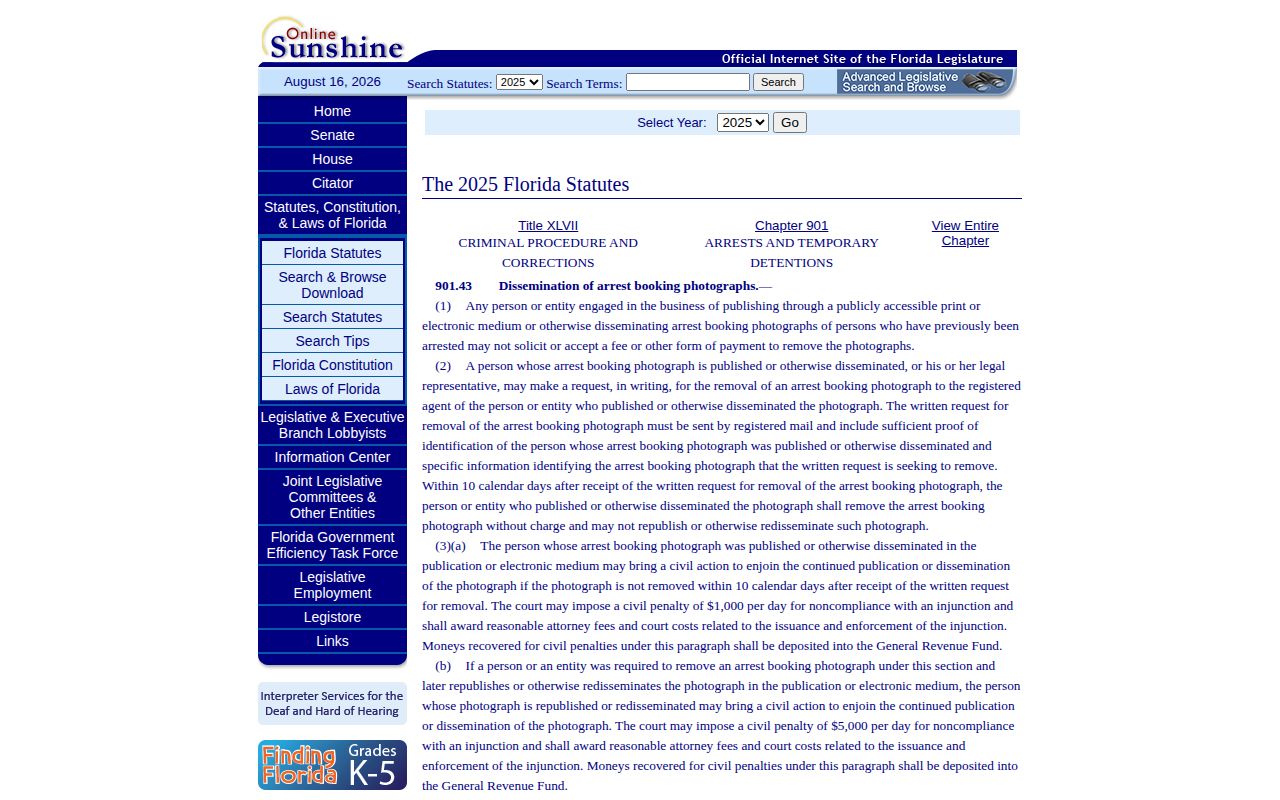
The statute also allows court relief and civil penalties in defined circumstances. Still, its reach is narrow. It creates no automatic deletion right against SLCSO, a general newspaper, or every page showing an arrest image. Never pay a removal demand. Keep the demand itself and turn to official consumer-protection or legal channels for advice.
Florida sealing or expungement starts with an FDLE Certificate of Eligibility. A complete application generally needs a certified disposition, fingerprints, and other case-specific documents. FDLE estimates roughly 12 weeks. The fee is a nonrefundable $75, and no expedited processing exists. A certificate stays valid for 12 months yet seals nothing by itself. A judge decides the petition, with eligibility hinging on the offense, disposition, prior relief, and criminal history.
Independent publishers need separate attention after a court order or favorable disposition. Recently Booked posts a no-fee correction or removal process. It covers qualifying dismissal, sealing or expungement, wrong-person, juvenile, duplicate, inaccurate, or outdated records. Mugshots.com offers a free record-maintenance policy for specified documented grounds and disposition updates. Busted Newspaper has a general contact form but no verified free-removal policy. No county policy was verified for Arrests.org or Mugshots.zone either, so promise nothing there.
Once the source page is gone or materially changed, Google's outdated-content tool can refresh a stale search result. It can't remove a live source, though. Let free publisher procedures and lawful court processes lead the way. Paid-removal offers should stay behind.
St. Lucie Juvenile Arrest Records
Florida does not treat juvenile access as all or nothing. Section 985.04 shields most juvenile records. But certain felony-equivalent cases, adult transfers, and adjudications can open the door to a name, address, photograph, or arrest report. Even then, a custodian can lawfully hold back a child's booking image from the web. Disclosure being allowed is not the same as disclosure being automatic.
St. Lucie's Clerk draws another line. Juvenile delinquency and dependency cases stay out of its public online system entirely. So a missing roster photo or a hidden docket proves nothing either way. The custodian has to weigh the law against the actual record in hand. When a request involves a child, identify the record precisely and expect a confidentiality review rather than an instant answer.
Note: A child's age alone never settles access, since Florida law hinges on the case type and its outcome.
Archived St. Lucie Booking Records
The five-day roster window limits what you can see. It does not limit what the sheriff keeps. SLCSO can hold a booking sheet, photograph, arrest affidavit, or jail-management file long after the public profile vanishes. Florida's General Records Schedule GS2 governs criminal justice agencies, and GS11 covers clerks. Those schedules set minimum periods only. An agency may keep a series even longer.
Chasing an older St. Lucie County arrest takes a few paths. Ask SLCSO Records for the item first. If it has moved on, request the record-series name. Most court cases dating to 1993 sit with the Clerk. When the arrest report came from PSLPD or FPPD, that police custodian holds the file, while SLCSO keeps the county jail photograph.
The Florida State Archives catalog can point to permanently valuable holdings. County booking photos do not land there by default, though. A catalog entry is a finding aid, not evidence of digitization. Name the creating agency, the rough years, the record type, and any known series or accession when you write to the archives.
Find St. Lucie County Busted Mugshots
Where a person sits in the custody process decides the best search. Someone just booked should surface in the SLCSO system once intake and publication finish. A person released within the short tail may still have a live profile, photo or not. An older county booking means going to Records. Florida prison or state supervision lands a person in FDC's system. Federal and immigration custody run through separate locators.
- Search the SLCSO roster by partial first or last name. Use the Today control for a same-day booking.
- Open the profile and compare inmate ID, date of birth, arresting agency, booking time, and offense entries.
- Check the five-day release report if recent release is possible. Do not treat that report as a booking feed.
- For an older or missing photo, submit a precise request to SLCSO Records.
- Use the Clerk’s case search for filed charges, dates, documents, and the final disposition.
- Use FDC, BOP, or ICE only when the custody stage fits that separate system.
A missing name settles nothing. Spelling, aliases, intake timing, release timing, and each source's scope all skew the results. Try another spelling. Check the date. Then fall back to the right custodian. One more limit: a roster can never confirm or rule out a warrant, because custody and warrants are separate questions.
St. Lucie Busted Roster Mismatch
St. Lucie has a real mismatch between labels and behavior. The sheriff's inmate-information page points to a "48 hour release report," but the live endpoint is titled "5 Day Release Report," and its web address still carries the number 48. Trust the five-day title shown on screen, while noting the conflict. The official SLCSO release report displays the current interface and window.
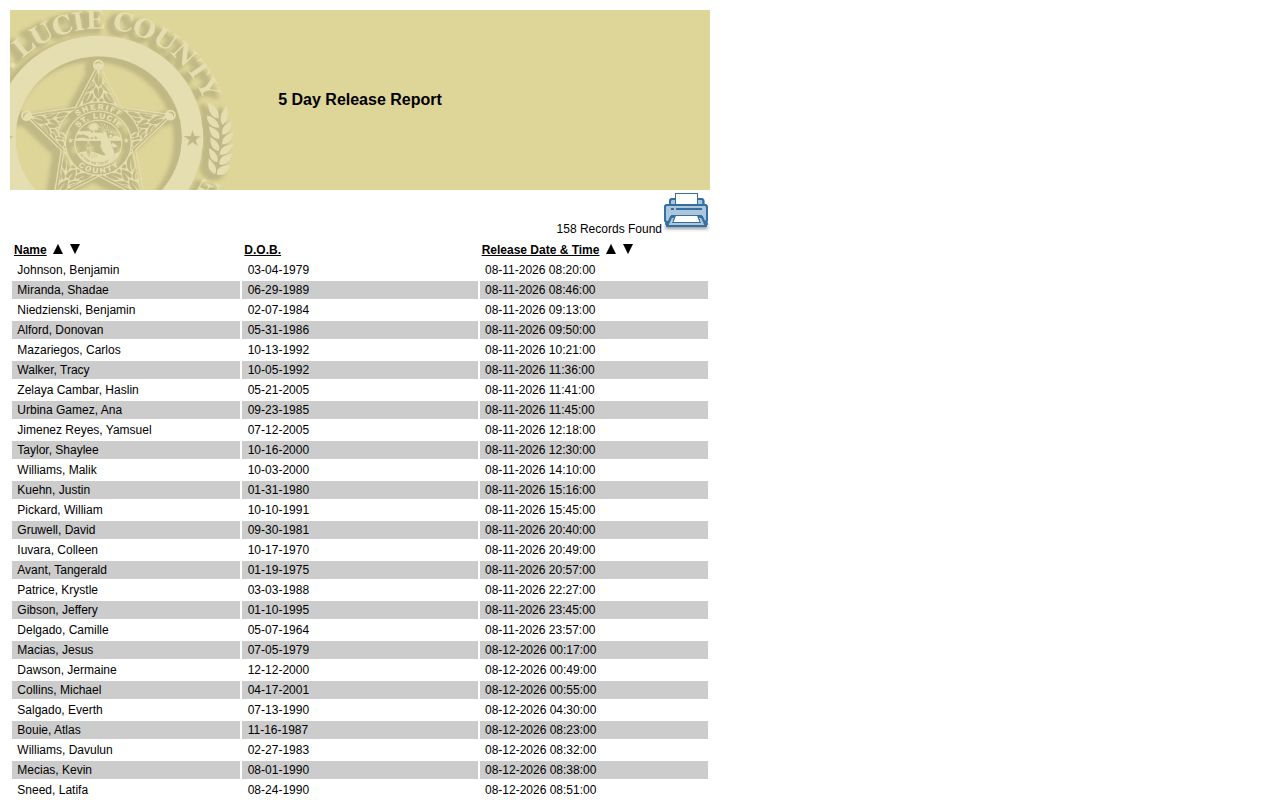
The report lists name, date of birth, release date, and release time. No mugshot appears. It answers one question: who left custody during the displayed period, not who was booked. The roster keeps entries searchable for five days after release, yet SLCSO promises a website booking photo only for people still incarcerated at the time of the search. A record can outlast its picture.
| Search field | How to use it | Limit |
|---|---|---|
| First name | Enter all or part of the name. | Spelling and aliases may affect results. |
| Last name | Enter all or part, or use % for all visible records. | The roster is not a permanent archive. |
| Today option | Select “Only Todays Bookings.” | No fixed publication delay is promised. |
| Profile | Open the result for custody, offense, bond, and photo fields. | A photo is promised only during incarceration. |
The official St. Lucie County inmate search serves as the county's primary roster and same-day booking interface.
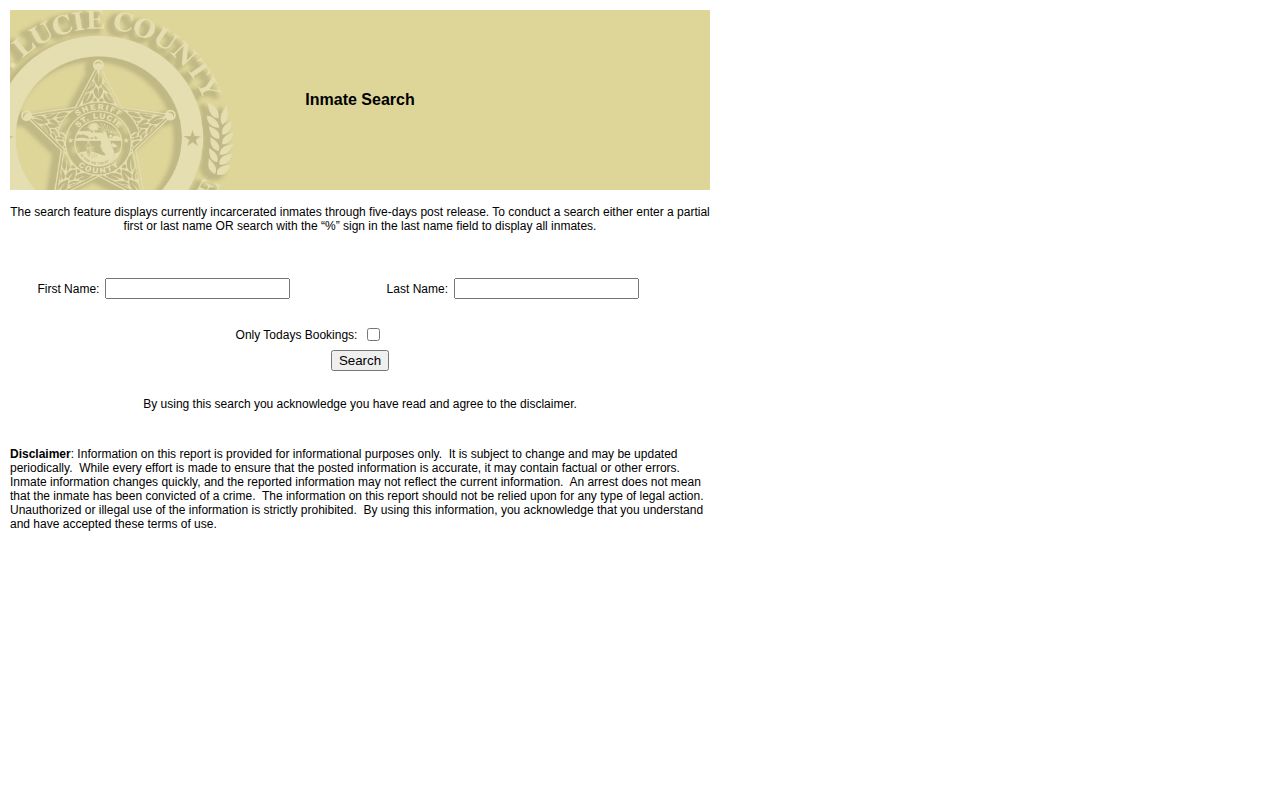
The form accepts partial names, and the Today control narrows the view to fresh bookings. Its own disclaimer warns that information changes quickly and is only updated periodically, so treat it as current rather than minute-by-minute.
St. Lucie County Arrest Feeds
St. Lucie County has no verified countywide feed for new bookings. That holds at the 24-hour, 48-hour, 72-hour, and weekly marks. The roster's Today option is the dependable official same-day view, built on the same profile fields and photo rule as the full roster. A new arrival may lag until jail processing and periodic publication catch up.
The sheriff's Daily Arrest Information page carries an Arrest Affidavits heading. Still, visitors may find no documents displayed there. An empty page never means "no arrests." The five-day release report is no stand-in either, since it tracks people leaving custody and omits photos.
Fort Pierce offers a partial municipal supplement. Its Police Blotter runs Monday through Friday and covers selected major incidents plus arrests of public concern. Anything from a weekend or closure period rolls into the next open business day. Port St. Lucie has no comparable verified blotter. The St. Lucie Village Marshal activity in council packets is not a booking feed.
Note: For dates outside the live window, request the booking sheet, affidavit, or photo, then match the case in the Clerk docket.
When St. Lucie Busted Records Appear
Web access and office access follow different clocks. The jail roster can show a St. Lucie County booking while a Fort Pierce written arrest affidavit remains unavailable over the weekend. The selective Fort Pierce blotter then rolls weekend events into its next business-day issue, and the Clerk docket appears later as a prosecution develops.
This staggered sequence explains why one source may be blank while another has a record. It does not prove an error. Start with the roster for current custody, use the municipal agency for its report, and use the Clerk for filed charges and court action. Records may be corrected as identity details, holds, release information, and orders arrive.
Question: Does a blank blotter mean no one was arrested? No. The blotter is selective, the sheriff page may lack exposed affidavits, and neither has the same scope as the county roster.
St. Lucie Booking Alerts
There is no sheriff-branded booking-photo app or inmate lookup feed here. Account, messaging, and visitation products from the jail solve other problems entirely. For official results, the browser roster is the St. Lucie County inmate search that counts.
SLCSO does run ALERT St. Lucie plus Facebook, Instagram, X, and YouTube accounts, and urgent safety notices sometimes surface there. Treat them with care, though. Posts get edited or pulled, and the agency picks what to highlight. A quiet feed proves nothing, and a single post is never a full arrest log.
VINE, run by FDC, belongs to the state-corrections stage. It sends location and event notices for people in FDC custody, covering transfers, escapes, work release, and even death. It is not a promise of alerts for every county jail booking or release.
St. Lucie Busted Mugshot Court Context
A county booking that moves into court lands with the St. Lucie Clerk's Court Case Search. That system carries the file. Most cases back to 1993 are included. You can see parties, filed charges, sentences, costs, dates, and documents. Search by name or case number. Registration unlocks some documents, though restricted case types stay out of public view.
What the jail lists can differ from what a prosecutor files. Charges get amended, dismissed, pleaded out, or tried. Felonies go through Circuit Criminal. Misdemeanors, criminal traffic, and ordinance matters go through County Criminal. Bond reviews, arraignments, trials, and sentencing are court events, not roster events.
Some files never reach the Clerk's online system. Juvenile delinquency, juvenile dependency, and mental-health cases are sealed from it. The Clerk's Research Department takes requests for permitted records that are not online. It quotes a usual two to seven business days, depending on complexity. That timeline belongs to the Clerk alone, not the sheriff's records process.
St. Lucie State and Federal Records
The Florida Department of Corrections search tracks felony offenders in state custody or under state supervision. County jail inmates, county probation, and fresh St. Lucie County arrests fall outside it. You can query by first and last name, a six-character DC number, or alias, and a filter narrows results to people with photos. Any available image shows on the detail page.
For finer slices, the FDC Offender Search menu splits its data into inmate, release, supervision, escape, and absconder databases.
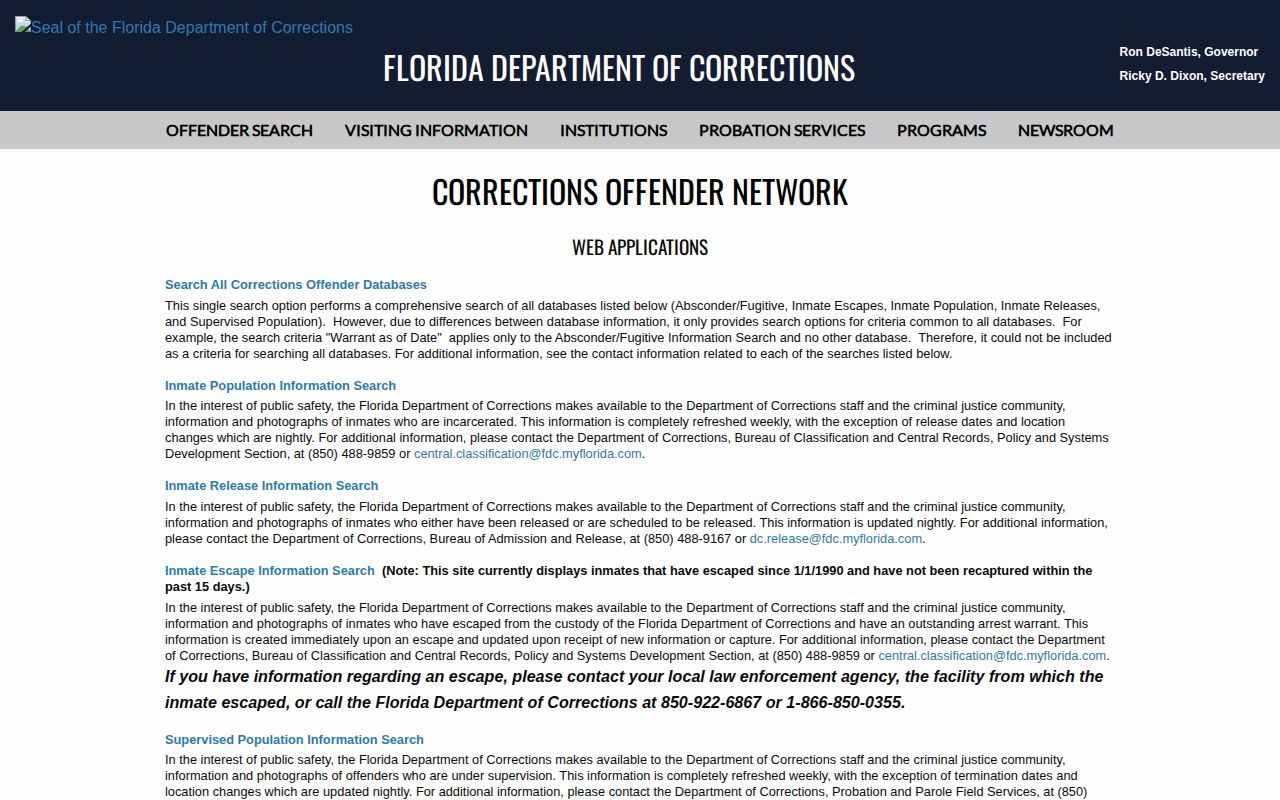
FDC refreshes its databases on two clocks. Inmate and supervised-population records get full weekly rebuilds, while certain release, location, and supervision changes post nightly. Those state schedules say nothing about the SLCSO roster.
Federal custody runs on separate tools. The Bureau of Prisons locator reaches back to 1982 and shows identifying and custody details, though it publishes no personal mugshots. ICE's Online Detainee Locator covers civil immigration detention and offers no booking photos either. The Marshals Service posts selected wanted notices, not a St. Lucie jail roster. Each system answers one custody question, and none answers them all.
Where St. Lucie Busted Mugshots Appear
Start any St. Lucie County mugshot lookup with official sources. They tell you who is in custody now, what the original record says, or how a case ended. Newsrooms and commercial archives come second at best. Their pages run stale, duplicate entries, mismatch people, or linger long after the official roster has moved on.
| Channel | Photo | Scope and access |
|---|---|---|
| SLCSO roster | Yes, when the person is incarcerated | Official current custody and five-day post-release search tail. |
| SLCSO Records | Requestable | Official route for older booking sheets, affidavits, and photos, subject to review. |
| FDC search | Often on detail page | Official state prison or supervision records, not recent county bookings. |
| Clerk search | Not a mugshot source | Official filed charges, dates, documents, and disposition. |
| Local news | Sometimes | TCPalm, WPTV, CBS12, and Hometown News publish selected stories. |
| Commercial county pages | Often | Unofficial discovery sources with uncertain completeness and retention. |
Busted Newspaper has a county page, but its visible cards were about a month old during research and no specific free-removal standard was found. Recently Booked describes a 30-day county view and multiple daily updates, while Mugshots.com appears to hold a much longer historical archive. Those are publisher claims and observations, not SLCSO guarantees.
Arrests.org had an indexed county URL, but live inspection was blocked, so current fields and cadence could not be verified. No stable Mugshots.zone St. Lucie County page was verified. These limits matter. None should be used to claim current custody, warrant status, or guilt. TCPalm, WPTV, CBS12, and Hometown News are editorial sources, not complete rosters. Arrest coverage may contain an agency-supplied image, but silence has no custody meaning. The county’s Arrest News page explains the story-to-record path.
St. Lucie Busted: Booked or Released
The same name can move through several record systems. Choosing by custody stage prevents false negatives and keeps a St. Lucie County arrest from being confused with a later state or federal record.
- Just booked
- Use the SLCSO Today search. A profile appears after processing, with a photo while the person remains incarcerated.
- In county custody
- Use the full SLCSO roster for current jail placement, offenses, bond, release fields, and an available photo.
- Released within five days
- Use the roster and release report. A searchable entry may remain, but the web photo is not promised.
- Released earlier
- Ask SLCSO Records for the jail record and photo, then use the Clerk to check the court outcome.
- State sentence or supervision
- Use FDC Offender Search for the state record and an offender photo when available.
- Federal or ICE custody
- Use the BOP or ICE locator for custody information, not a county booking photo.
Question: Why does a released person show up in search results without a photo? SLCSO keeps a record visible for five days after release. Photos, though, appear only for people still in custody when the search runs.
St. Lucie Village Booking Path
Three incorporated places sit inside St. Lucie County, and each adds its own local layer. Port St. Lucie Busted Mugshots come through a municipal police department with formal city records channels, though no verified daily arrest blotter exists. Custodial arrests still land in the county jail system. There, the arresting-agency field can flag PSLPD as the source.
Fort Pierce, the county seat, runs its own department too. FPPD posts a selective weekday blotter, but anyone booked into St. Lucie County Jail still shows up through SLCSO. The blotter adds narrative context for picked events. It is not a full arrest or mugshot list.
St. Lucie Village works differently. An appointed Marshal serves the town rather than a standard department with a public arrest portal. Marshal activity may surface in council packets, but those reports are not arrest feeds and hold no mugshot gallery. County 911 and the SLCSO roster remain the practical booking channels. Town records stay with the town clerk; a jail photograph belongs to SLCSO.
These differences are why a single city search can miss a record. The shared county jail portal should follow the city agency's report, and the Clerk should follow both for the disposition. Each of the three city pages keeps that chain tied to the right local agency.